On trans women
The very first “Britannia et Hibernia”
Good evening. This is Britannia et Hibernia, a new section of the newsletter that focuses entirely on the two islands that the Romans called in this way: Great Britain and Ireland, respectively! The section consists mainly of a press review of the main newspapers of the United Kingdom and the Republic of Ireland: however, the aim is not just to give the news of the day, but to reflect upon them and to write about the broader history, culture, politics and economy of these two fantastic islands, starting from ordinary newspaper articles.
Today, in Britain and Ireland two stories dominate the headlines of both daily newspapers and online newspaper, namely the ruling of the UK Supreme Court on the legal status of trans women and a shocking poll on the front page of the Irish Times (see front page below). In this newsletter, we will focus only on the former, given that it is just its first edition and a trial more than a real and structured thing: however, if you want to know more on the Irish poll, you should read this analysis article.
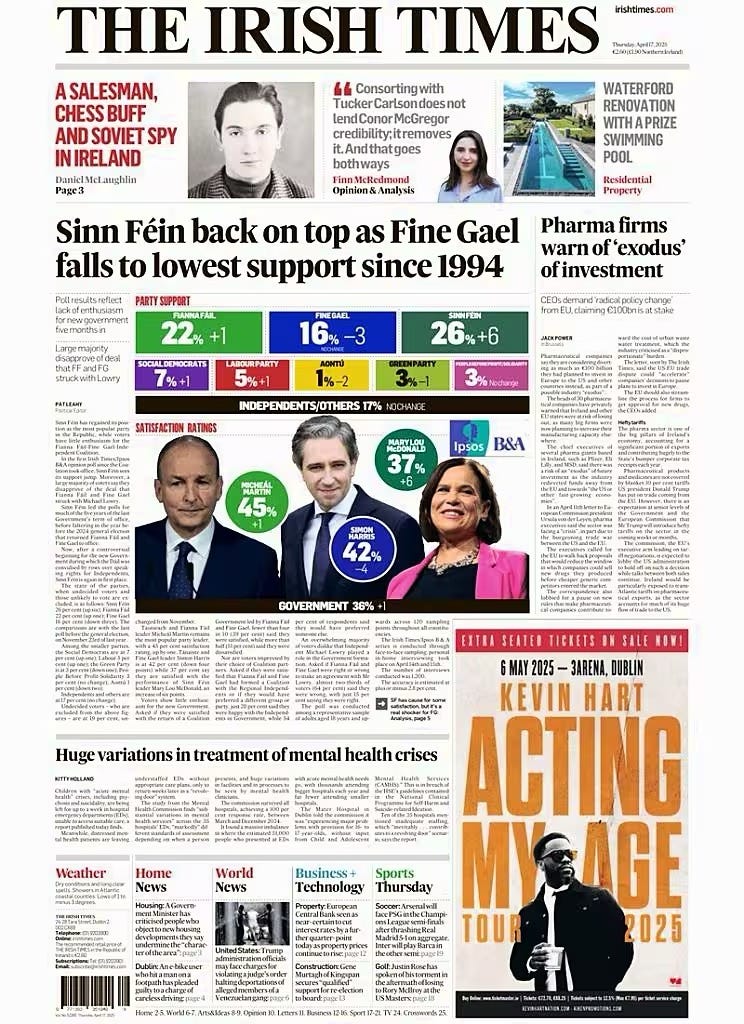
Before starting our analysis, however, here is another reading recommendation. It consists of a speech given at Queen’s University in Belfast by former US Senator George Mitchell, a key architect of the peace process in Northern Ireland that culminated with the Belfast or Good Friday Agreement of 1998, signed on 10th April of that year. A transcript of the speech is available on the website of the Irish Times, and in this time of tensions, wars and upheavals all around the world a message of unity and hope is well worth a read! Now, back to today’s papers!
Common sense or a crushing blow?
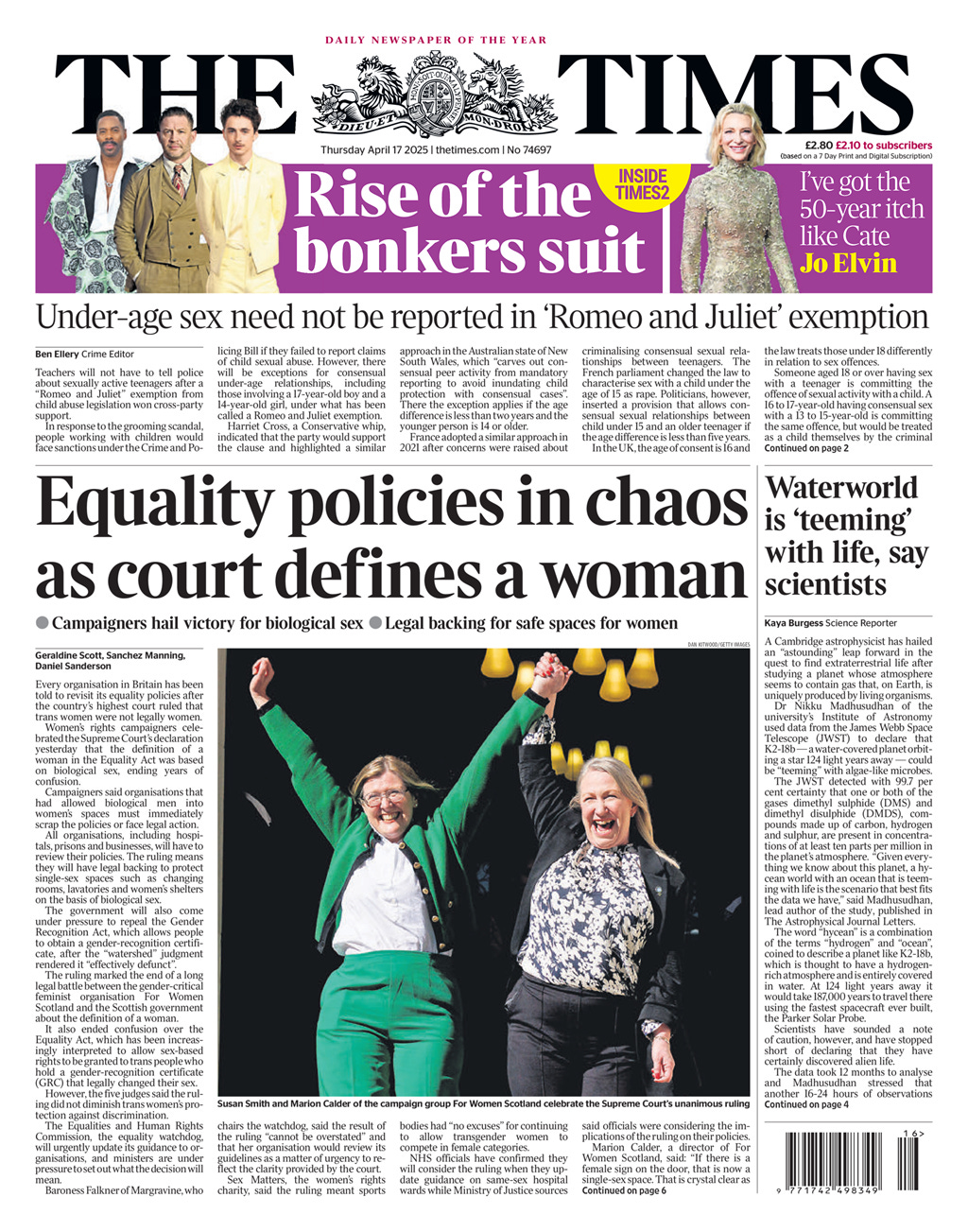
Yesterday, the Supreme Court of the United Kingdom in a unanimous decision issued a ruling that states that trans women are not included in the definition of women given by the Equality Act, a piece of legislation passed in the last year of Gordon Brown’s Labour government (2010) to fight discrimination and promote equality. Therefore, according to the Court’s decision, the definition of ‘woman’ is based purely on sex, and not on gender, in effect excluding trans women from the definition.
The matter raises huge ethical questions that go well beyond the goal of this newsletter, which is to report and analyse how the UK press covered the story. Unsurprisingly, the United Kingdom is a very divided country on the issue of trans people, but whereas in countries like the United States the so-called culture wars (or the ‘woke culture’) have been central to the political discussion, with Democrats and Republicans accusing each other of promoting extremist views, in Britain the impact of these issues on politics has been more limited. However, newspapers have long debated the matter with different and conflicting interpretations: the stance of the well-known writer J.K. Rowling, in support of the biological sex-only definition, has equally helped the story to gain national attention. The Daily Telegraph, a right-wing newspaper, titles bluntly on its front page ‘Trans women are not women’, while its own editorial frames the ruling as “A long overdue victory for women’, celebrating the Supreme Court decision. Instead, The Guardian, a left-leaning daily, stresses on its front page that the ruling ‘may have [a] far-reaching impact on trans rights’: also on The Guardian, Robin Moira White, a discrimination barrister, expresses her doubts about the ruling by starting her opinion article in this way:
A person has to be tough to be transgender. Given the problems that can be associated with coming out to family, friends and work colleagues, the constant vilification of trans people by certain parts of the media and on social media and the internal emotional turmoil transition entails, it requires mental strength beyond the ordinary.
If you look for a piece that explains the reactions, consequences and future implications of the ruling on each side this debate, then this article is for you.
Leaving aside the debate, it is interesting to understand the political implications of all this, but to do so now is also a bit premature: in the next few days and weeks, we will have a clearer and more comprehensive picture. In the meantime, however, Peter Walker and Severin Carrell of The Guardian note wisely that the Court might have handed a favour to politicians in Westminster and the rest of the country: by defining what a woman is and is not on a legal basis, in effect the Supreme Court has avoided a political decision on the issue, something that would have divided the various parties, especially on the left. The Labour Party and the Scottish National Party, in particular, would have seen their voters and MPs divided: even the Prime Minister, Sir Keir Starmer, seems to have changed his view on the matter in order to avoid criticism. As for the Conservatives, their leader, Kemi Badenoch, celebrated the ruling yesterday, but that Court decision will probably deprive her of a possible attack line against Labour and the Prime Minister. But again, the full extent of the political reactions and implications is yet to be seen.
Miscellaneous recommendations
Historically, Northern Ireland’s economy was much more robust than that of the Republic: for instance, in the 19th Century, while Ulster was an industrial hub, the rest of the island remained an economy mainly dependent on agriculture. However, in the last few years, with the aftermath of the Troubles in the North and with the rise of the South, today the European hub of big American companies, the reverse is happening. This Irish Times editorial explains why this gap is not only happening, but also growing.
Netflix’s Adolescence is definitely the must-watch series of the moment. However, given that it is set in the North of England, will it do any economic good for Britain? The Economist finds out.
Catherine of Aragon is a pivotal figure for English politics in the 16th Century: having married two Tudors, she stands out as one of the reasons why King Henry VIII split from Rome and founded the Church of England, being unable to divorce a wife who had not given him a male heir. This episode of In Our Time from BBC Radio 4 discusses such an important figure (listeners in the UK can find it on BBC Sounds).